
Apex exporters body FIEO on Tuesday expressed serious concerns over high US tariffs on Indian goods and said that textiles and apparel manufacturers in Tirupur, Noida, and Surat have halted production amid worsening cost competitiveness due to these steep duties. The US duties on Indian goods will increase to 50 per cent from August 27.

Stock markets will be driven by RBI's interest rate decision, tariff-related developments, global trends and trading activity of foreign investors in this holiday-shortened week, analysts said.

Amid US-China trade tensions and economic vulnerabilities, India must seize the 'China +1' opportunity, deepen reforms, secure FTAs, and globalise its firms for long-term growth, suggests Ajay Shah.
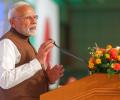
Showcasing India as an attractive investment destination, Modi said the country has political and economic stability as well as transparency and predictability in policy decisions.

After months of discord, the Tata Trusts appear to be moving towards reconciliation, with recent reappointments and open exchanges signalling a return to cooperative governance.

HCLTech reported flat net income of Rs 4,235 crore in the second quarter of 2025-26 (Q2FY26) compared to last year, even as its revenue was up 10.7 per cent to Rs 31,492 crore helped by financial services and technology business verticals.

'The petrol lobby is very rich and strong.'

Electric vehicle (EV) manufacturers breathed a sigh of relief after the GST Council on Wednesday night retained the concessional 5 per cent rate on EVs, though they now face competition from small petrol and diesel cars, which will attract a lower 18 per cent levy.

HAL's order book amounts to Rs 2.45 trillion by end of Q2FY26, implying a book-to-bill ratio of 32 times based on FY25 revenue.
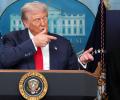
In trade negotiations, as in chess, sometimes you need to accept a temporary disadvantage to secure a better long-term position, points out Sonal Varma, chief economist (India and Asia ex-Japan) at Nomura.

The private consortium would invest more than Rs 1,200 crore over the next five years to launch a constellation of 12 state-of-the-art Earth Observation satellites equipped with panchromatic, multispectral, hyperspectral, and microwave SAR (synthetic aperture radar) sensors.

Concerns over weakening demand for Indian pharmaceutical (pharma) drugs in the US - their largest export market - have weighed heavily on investor sentiment this year. While the Nifty 50 has gained 6.02 per cent year - to - date (as on September 15), the Nifty Pharma index has declined 5.18 per cent, National Stock Exchange data shows.


Prime Minister Modi urged the people of the country to take pride in selling and buying indigenous goods.

As the potential threat of a steep 200 per cent tariff on pharmaceutical imports hangs in the air, analysts and industry insiders feel that focus on exports to non-US regions as well as domestic market will increase as a long-term trend. US President Donald Trump told CNBC's Squawk Box in the first week of August that planned tariffs on import of pharmaceutical products to the US could eventually reach up to 250 per cent.

For kids in the United States, the tariff imposed by the Donald Trump administration on countries like China may no longer be a child's play, as toy prices are predicted to touch record highs this Christmas season. However, for India's toy export industry, which was ready to take giant strides in the sector by bagging heavy orders from the US retail giants like Walmart, Amazon, and Target Corporation, gaining from the China-Plus-One policy, the US tariffs came as a heavy jolt.

The escalation in the US-China trade war is expected to help India increase its exports and attract investments from American companies, think tank GTRI said on Friday. He said that last month, the US Senate introduced two bills that could intensify the trade war and have major global economic impacts if passed.

To shield against US President Donald Trump's tariff shock, analysts have been advising investors to focus on stocks of domestic-oriented companies, rather than export-centric ones, to minimise potential losses.
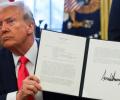
The sweeping tariffs proposed across sectors by US President Donald Trump are scheduled to be imposed starting April 2, with most analysts worried about their impact on companies, and in turn the financial markets. Recently, the US administration signaled that it will impose sectoral tariffs on energy, pharmaceuticals, semiconductors, agriculture, copper, and lumber.

Oil marketing companies (OMCs), paint manufacturers, tyre producers, and aviation stocks witnessed significant gains as Brent crude oil prices slipped below $70 per barrel. The price drop came after a double blow: The US imposed tariffs on Canada and Mexico, including energy imports, and OPEC+ - the group of major oil-producing nations including Russia - announced an output increase of 138,000 barrels per day, the first such hike since 2022.

'Our vision is to innovate as many products as we can and solve as many problems as possible.'

India's services sector activity expanded at the slowest pace in over two years in January amid softer increases in sales and output, a monthly survey said on Wednesday. The seasonally adjusted HSBC India Services PMI Business Activity Index fell from 59.3 in December to 56.5 in January -- its lowest level since November. In the Purchasing Managers' Index (PMI) parlance, a print above 50 means expansion, while a score below 50 denotes contraction.

In IT, male supervisors out-earn their female counterparts.

India is set to become the world's fourth-largest economy in 2025, but slow income growth, lack of structural change, and rising inequality highlight the gap between progress and real transformation.

On August 7, the US president announced doubling tariffs on Indian goods to 50 percent for India's purchases of Russian crude oil, but gave a 21-day window to negotiate an agreement.

The USA's steep 50 per cent tariffs on Indian goods entering America will severely impact exports and job creation in labour-intensive export sectors such as shrimp, apparel, leather and gems and jewellery. Exporters said that the imposition of a 25 per cent penalty on India over and above the 25 per cent tariffs move will disrupt the flow of Indian goods to its largest export market.

Recent documents by NITI Aayog and periodic labour force surveys on employment show that the importance of agriculture is rising in the Indian economy.

Finance Minister Nirmala Sitharaman on Thursday asked India Inc to take advantage of the policies and reforms undertaken by the government and no longer hesitate to invest more and expand capacities. Sitharaman also asked the industry to partner with the government for skilling the youth and also to engage with the government throughout the year, and not just before the Budget.

India's services PMI recovered from its ten-month low in September to reach 58.5 in October supported by strong expansions in output and new business, which in turn boosted job creation, a monthly survey said on Wednesday. The seasonally adjusted HSBC India Services Business Activity Index increased from 57.7 in September to 58.5 in October, as robust sales pipelines and strong demand conditions supported the upturn in business activity. In the Purchasing Managers' Index (PMI) parlance, a print above 50 means expansion, while a score below 50 denotes contraction.

Indian information-technology (IT) service providers are likely to report another quarter (July-September) of low, single-digit growth owing to macro uncertainties, chiefly emanating from America, with no respite in sight even in the second half of the year.

India's industrial production growth decelerated to a six-month low of 2.9 per cent in February 2025, mainly due to poor performance of the manufacturing, mining and power sectors, according to official data released on Friday. The government also revised upward the industrial growth figure to 5.2 per cent for January 2025 from the provisional estimate of 5 per cent released in March.

After adding 11.7 million workers in the October 2022-September 2023 period from the pandemic lows in April 2021-March 2022, total workers employed in the vast informal sector in India - at 109.6 million - still remains below the pre-pandemic period.

Colliers reports that GCC leasing has jumped from 4.6 million square feet in 2021 and is expected to hit 10.6 million square feet by 2025 -- a clear sign that multinationals see Bengaluru as a long-term base.

The decision to hike US H-1B visa application fee to $100,000, trade talks and the GST rate cut will be the key drivers for stock market movement this week, analysts said.

"This time, the country partner of the trade show is Russia. That means we are further strengthening a time-tested partnership through this trade show," the Prime Minister said.

'Stop fearing 'No' and build your empire. 'By embracing rejection, you gain clarity, data and a stronger team, paving the way for inevitable growth,' Mamaearth Co-Founder Ghazal Alagh tells aspiring entrepreneurs.

'An HAL-private sector tieup is a possibility.'

'As one of many immigrants at Nvidia, I know the opportunities we've found in America have profoundly shaped our lives.'

With demand for information-technology (IT) services in North America still sluggish, Europe has become a source of optimism for Indian companies because it is delivering steady gains over the past two years and continuing to outperform in the latest quarter. Yet analysts caution a full-scale revival will require a rebound in the United States (US), particularly in manufacturing, retail, and BFSI (banking, financial services, and insurance), because Europe contributes only about a third of the revenues.
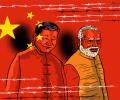
The bilateral trade between India and China has been growing at a healthy rate, but the trade gap remains sharply tilted in Beijing's favour. India has time and again flagged its concern over the ballooning trade deficit and the non-trade barriers faced by Indian goods in the Chinese market.
